

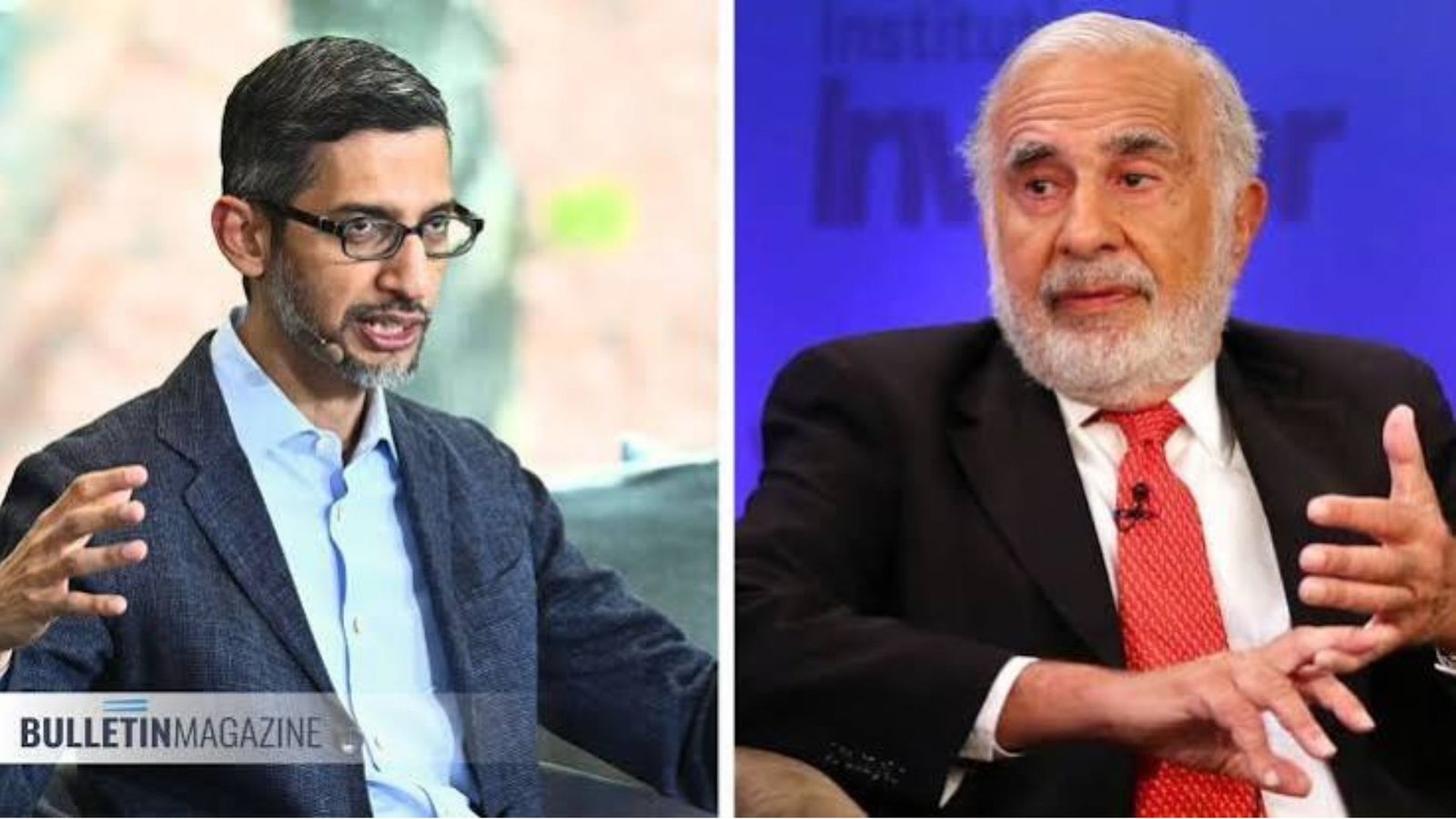
Two powerful names in business often raise one interesting question: Is there a connection between Google’s CEO and one of America’s best-known activist investors? Confusing their careers can lead to misleading claims about corporate influence and investments. Understanding sundar pichai and carl icahn reveals two very different approaches to business success, technology leadership, and shareholder value—and explains where their professional worlds overlap.
Who Are Sundar Pichai and Carl Icahn?
Sundar Pichai is the CEO of Google and Alphabet, while Carl Icahn is an American billionaire investor known for shareholder activism. Both have influenced major businesses, but they exercise their power in different ways.
Pichai manages a technology company with products used by people across the world. Icahn invests in companies and has historically challenged management decisions to seek financial returns for shareholders.
Their careers offer a useful comparison between building a successful business from inside and influencing companies as an outside investor.
Quick comparison table
| Feature | Sundar Pichai | Carl Icahn |
|---|---|---|
| Full name | Pichai Sundararajan | Carl Celian Icahn |
| Born | June 10, 1972 | February 16, 1936 |
| Nationality | American, born in India | American |
| Main profession | Technology executive | Investor and businessman |
| Best known for | Leading Google and Alphabet | Activist investing |
| Major organization | Alphabet Inc. | Icahn Enterprises |
| Career background | Engineering and technology management | Finance and investments |
| Leadership approach | Product innovation and long-term growth | Shareholder activism and financial performance |
| Main business focus | AI, digital services, cloud computing, advertising | Investments, corporate governance, capital allocation |
| Major industry connection | Google, Android, Chrome, YouTube | Apple, eBay, Netflix, and other investments |
| Source of influence | Executive and board leadership | Investment ownership and shareholder influence |
| Direct relationship | No publicly verified direct relationship identified | No publicly verified direct relationship identified |
Are Sundar Pichai and Carl Icahn Personally Connected?
There is no reliable public evidence establishing a personal friendship, family relationship, business partnership, or direct professional collaboration between Sundar Pichai and Carl Icahn.
Their names belong to the same broad business landscape, but appearing in discussions of major technology companies does not establish a relationship.
The available primary documents establish two relevant facts: Pichai leads Alphabet, and Icahn publicly campaigned for financial changes at Apple, Google’s longtime competitor.
What is confirmed?
- Pichai became Google CEO in 2015 and Alphabet CEO in 2019.
- Icahn has a documented history of activist investing.
- Icahn communicated directly with Apple CEO Tim Cook.
- Apple and Google have competed in mobile operating systems, devices, and digital services.
- The reviewed primary sources do not establish a direct transaction or collaboration between Pichai and Icahn.
Key distinction: An indirect connection through the technology industry is not evidence of a direct personal or financial relationship.
Who Is Sundar Pichai? Early Life and Education
Sundar Pichai was born on June 10, 1972, in Madurai, Tamil Nadu, India. He grew up in Chennai and developed an interest in engineering and technology.
He studied metallurgical engineering at the Indian Institute of Technology Kharagpur. He later earned a master’s degree from Stanford University and an MBA from the Wharton School of the University of Pennsylvania.
These qualifications helped prepare him for roles requiring technical understanding, product judgment, and business leadership.
Sundar Pichai’s educational background
| Institution | Qualification | Field |
|---|---|---|
| IIT Kharagpur | Bachelor of Technology | Metallurgical engineering |
| Stanford University | Master of Science | Materials science and engineering |
| University of Pennsylvania, Wharton School | MBA | Business administration |
Before becoming one of the most prominent technology executives, Pichai worked in engineering and business consulting.
His career demonstrates how technical expertise can develop into global business leadership.
How Did Sundar Pichai Become Google CEO?
Pichai joined Google in 2004. His early responsibilities included product management, particularly work connected with Google’s browser and software products.
He later played major roles in Chrome, Chrome OS, Android, and other Google platforms.
His responsibilities continued to expand as Google grew.
Important career milestones
| Year | Career milestone | Importance |
|---|---|---|
| 2004 | Joined Google | Began his career at the company |
| 2008 | Google Chrome launched | Helped establish a major web browser |
| 2013 | Took responsibility for Android | Expanded his leadership across mobile technology |
| 2014 | Became senior vice president of products | Oversaw major Google products |
| 2015 | Became Google CEO | Took responsibility for Google’s business operations |
| 2017 | Joined Alphabet’s board | Expanded his governance responsibilities |
| 2019 | Became Alphabet CEO | Took leadership of Google’s parent company |
| 2020s | Advanced Alphabet’s AI strategy | Expanded focus on AI products and infrastructure |
Pichai’s advancement reflects years of experience managing increasingly important products and teams.
His position also differs from that of an ordinary employee or outside investor. As CEO, he helps determine company strategy, allocates resources, and answers to Alphabet’s board.
Who Is Carl Icahn? Background and Business Career
Carl Icahn was born on February 16, 1936, in Queens, New York City.
He graduated from Princeton University in 1957 with a degree in philosophy. After pursuing other interests, he began his Wall Street career in 1961.
In 1968, he established Icahn & Co., a securities business focused on investment strategies that included arbitrage and options trading.
During the following decades, he became famous for buying significant positions in companies and challenging their management.
Important stages of Carl Icahn’s career
| Period | Development | Business significance |
|---|---|---|
| 1957 | Graduated from Princeton | Completed university education |
| 1961 | Entered Wall Street | Began his finance career |
| 1968 | Founded Icahn & Co. | Established his investment business |
| Late 1970s | Began acquiring large ownership positions | Expanded into corporate influence |
| 1980s–2000s | Became involved with major companies | Built his reputation as an activist investor |
| 2010s | Took public positions involving companies including Apple | Increased attention on corporate capital allocation |
| 2020s | Continued association with Icahn Enterprises | Remained influential through investment ownership and governance |
Icahn’s career differs from Pichai’s because he built his influence mainly through investments rather than by managing a large technology company.
His approach often focuses on whether company assets, cash, or management decisions deliver enough value to shareholders.
What Is the Real Business Connection Between Sundar Pichai and Carl Icahn?
The most meaningful connection between sundar pichai and carl icahn comes through the technology industry, especially the historical rivalry between Apple and Google.
Icahn became a major Apple shareholder during the 2010s. He publicly argued that Apple should use more of its cash to repurchase its shares.
Google was one of Apple’s largest competitors in the smartphone market. Google’s Android operating system competed directly with Apple’s iOS platform.
How the indirect connection works
- Google develops Android and services used across smartphones.
- Apple produces iPhones and operates the iOS ecosystem.
- Icahn invested heavily in Apple and advocated changes to its financial strategy.
- Pichai held increasingly senior product leadership roles at Google during the same period.
- Both men’s work therefore touched the competitive and financial landscape of major technology companies.
Icahn’s communications about Apple sometimes referred to Google directly.
For example, a 2014 letter to Apple CEO Tim Cook discussed Apple’s competitive position against Android. It also argued that Apple’s shares were undervalued.
This provides a documented industry connection without proving direct interaction between the two individuals.
Did Carl Icahn Invest in Google or Alphabet?
No major activist investment by Carl Icahn in Google or Alphabet has been established by the primary sources reviewed for this article.
This distinction matters because Icahn has invested in numerous public companies, including technology businesses. However, his investment history should not be treated as proof that he invested in every major technology company.
An investor may own shares indirectly through funds, trading accounts, or other arrangements without making a public activist campaign.
How can investors verify ownership?
Investors can examine:
- SEC Schedule 13D filings, commonly associated with significant ownership and potential efforts to influence control.
- Schedule 13G filings for qualifying beneficial ownership disclosures.
- Form 13F reports showing certain institutional investment holdings.
- Corporate proxy statements and annual reports.
- Official investor presentations and public statements.
These documents have different reporting requirements and limitations.
A missing filing does not prove that an investor owns zero shares. It only means the reviewed disclosures do not establish the claimed investment.
For that reason, claims of a large Icahn position in Alphabet should include a dated regulatory filing or another reliable primary document.
How Did Carl Icahn Influence Apple?
Carl Icahn’s involvement with Apple offers a clear example of activist investing.
In 2013, Icahn began publicly discussing his Apple investment and called for the company to increase its share repurchase program.
He believed Apple’s shares were worth more than their market price and argued that buying back shares could benefit remaining shareholders.
Timeline of Carl Icahn’s Apple involvement
| Year | Key event | Why it mattered |
|---|---|---|
| April 2013 | Apple announced an expanded capital return program | Established a major company-led buyback plan before Icahn’s public campaign |
| August 2013 | Icahn disclosed a major Apple investment | Brought attention to his views on Apple’s valuation |
| October 2013 | Icahn wrote to Tim Cook | Advocated a substantially larger share buyback |
| January 2014 | Icahn issued another public letter | Continued pressure for higher repurchases |
| February 2014 | Icahn withdrew his shareholder proposal | Cited Apple’s repurchase activity and other developments |
| 2015 | Icahn continued publishing positive views about Apple | Demonstrated his ongoing focus on the company |
Apple’s buyback program did not begin because of Icahn.
The company had already announced a substantial capital return expansion in April 2013. Icahn later sought faster or larger repurchases.
That sequence is important when judging the results of shareholder activism. It prevents the mistake of giving one investor sole credit for decisions that company management had already started.
Icahn’s letters and SEC records confirm his campaign, but they do not establish that every subsequent Apple financial decision resulted from his influence.
What is a share buyback?
A share buyback occurs when a company purchases its own outstanding shares.
Suppose a company earns $100 million and has 100 million shares outstanding. Its earnings per share would be $1.
If the number of shares fell to 90 million while earnings stayed unchanged, earnings per share would rise to approximately $1.11.
However, buybacks require money. They do not automatically increase a company’s underlying business value.
The price paid, financing costs, business outlook, and alternative uses of cash all matter.
How Do Their Leadership Styles Compare?
The comparison of sundar pichai and carl icahn highlights a fundamental difference between operating leadership and investment activism.
Pichai guides the strategy and day-to-day direction of a global technology organization. Icahn’s influence has historically come from owning investments and demanding changes that he believes will improve financial performance.
Leadership comparison table
| Leadership factor | Sundar Pichai | Carl Icahn |
|---|---|---|
| Primary responsibility | Running a technology company | Managing investments and influencing companies |
| Strategic priority | Products, users, technology, and business growth | Investment returns and capital allocation |
| Decision-making role | Internal executive leadership | External investor or controlling shareholder |
| Main area of expertise | Technology and organizational management | Corporate finance and shareholder activism |
| Common business challenge | Maintaining innovation while growing revenue | Identifying undervalued assets and encouraging change |
| Typical time horizon | Multi-year corporate development | Depends on the investment opportunity |
| Accountability | Board, shareholders, employees, customers, regulators | Investors, partners, companies, and applicable regulators |
| Principal influence | Organizational authority | Ownership rights, public campaigns, and negotiations |
Neither leadership model guarantees success.
A company can invest heavily in innovation without generating enough return. An activist investor can also make financial proposals that create risks or overlook long-term business needs.
The strongest decisions balance immediate financial performance with future competitiveness.
What Is Sundar Pichai’s Business Strategy at Alphabet?
Pichai’s work at Alphabet Inc. centers on developing products, expanding services, and maintaining the company’s competitive position.
Alphabet generates revenue from multiple businesses, with advertising historically providing the largest share.
Its major areas include Google Search, YouTube, Google Cloud, Android, subscriptions, and other technology projects.
Four important parts of Alphabet’s strategy
Artificial intelligence
Alphabet develops AI models, computing infrastructure, and AI-powered features across its products.
Pichai has placed AI at the center of the company’s strategy, including developments involving Gemini and Google Cloud.
Search and advertising
Google Search helps users discover information and supports an important advertising business.
Management must balance user experience, advertiser needs, competitive pressure, and the growing role of AI-generated answers.
Cloud computing
Google Cloud provides computing infrastructure, data tools, and AI services to organizations.
It competes with Amazon Web Services and Microsoft Azure.
Long-term research
Alphabet invests in projects that may take years to produce commercial results.
Such investments create opportunities but also require careful financial management.
In Alphabet’s April 2026 proxy statement, the company emphasized responsible AI development, product improvements, and board oversight of its long-term strategy.
What Is Carl Icahn’s Investment Strategy?
Icahn is associated with activist investing, a strategy that involves buying ownership stakes and pushing for changes at companies.
These changes may involve management, board representation, business structure, asset sales, or shareholder distributions.
How activist investing works
- Identify an opportunity. An investor searches for a business believed to trade below its potential value.
- Study financial performance. The investor reviews cash flow, debt, assets, operating costs, and competitive position.
- Acquire shares. A meaningful ownership stake can provide economic exposure and certain shareholder rights.
- Communicate proposals. The investor may contact management or publish recommendations.
- Seek changes. The proposed changes may involve strategy, governance, or allocation of capital.
- Evaluate the outcome. The investor measures performance against the original investment thesis.
Activist investors do not always win board seats or achieve their objectives.
Management can reject proposals, shareholders can disagree, and market conditions can change.
Advantages and risks of shareholder activism
| Potential advantage | Possible risk |
|---|---|
| Improves management accountability | May create conflict with leadership |
| Encourages more disciplined spending | May reduce funds available for future investments |
| Identifies underused company assets | Asset valuations may prove inaccurate |
| Pushes for clearer business priorities | Can distract employees and management |
| Highlights governance problems | Proposed solutions may favor short-term results |
| Encourages shareholder participation | Activist interests may differ from those of other stakeholders |
Icahn’s Apple involvement shows the practical importance of studying both the investor’s proposals and the company’s existing strategy.
Sundar Pichai vs. Carl Icahn: Who Has More Business Influence?
There is no single objective measurement that determines which person has more influence.
Sundar Pichai and Carl Icahn exercise different kinds of power. Pichai influences technology products and business operations, while Icahn has historically influenced corporate financial and governance decisions through investing.
Influence by business category
| Category | Main distinction |
|---|---|
| Technology products | Pichai has direct leadership responsibility at Google |
| Artificial intelligence | Pichai leads a company developing major AI products and infrastructure |
| Activist investing | Icahn has a long record of public shareholder campaigns |
| Corporate management | Pichai exercises executive authority |
| Shareholder activism | Icahn has experience challenging company decisions |
| Consumer reach | Google’s services connect Pichai’s leadership to worldwide digital products |
| Capital allocation campaigns | Icahn is known for publicly advocating financial changes |
| Business ownership | Icahn operates through significant investments and affiliated entities |
A useful way to understand the distinction is to ask what kind of decision each person can influence.
Pichai can direct executives and teams working within Alphabet, subject to corporate governance. Icahn can advocate changes at businesses where he holds relevant ownership rights, but he does not automatically control their management.
This is a more meaningful comparison than ranking the two solely by wealth or public recognition.
How Do Sundar Pichai and Carl Icahn Approach Shareholder Value?
Although their methods differ, both careers involve decisions that can affect shareholders.
Pichai’s role includes developing Alphabet’s business and supporting its ability to generate sustainable returns.
Icahn has frequently emphasized shareholder value through financial restructuring, governance changes, or distributions of capital.
Two approaches to creating value
| Business question | Executive-led approach | Activist-investor approach |
|---|---|---|
| How should cash be used? | Balance investment, operations, and shareholder returns | Question whether excess cash should be returned or used differently |
| How can earnings improve? | Build products, increase revenue, improve efficiency | Evaluate costs, assets, management, and capital structure |
| Who drives change? | Management and board | Shareholders seeking to influence management and board |
| What supports long-term growth? | Product innovation and business expansion | Better use of capital and stronger business performance |
| What could go wrong? | Spending too much on unsuccessful projects | Reducing investment or taking excessive financial risks |
Consider a technology company with $10 billion available for investment.
Management might prefer spending part of it on AI infrastructure, new products, and research. An activist investor might argue that some cash should instead fund buybacks or debt reduction.
Neither decision is automatically better.
The correct choice depends on expected investment returns, market valuation, financial risks, and the company’s competitive needs.
That is the central business lesson behind the comparison of sundar pichai and carl icahn.
What Can Business Leaders Learn From Sundar Pichai and Carl Icahn?
The careers of sundar pichai and carl icahn provide practical lessons for entrepreneurs, investors, executives, and students.
Their experiences show why successful leadership requires more than a strong idea. Leaders must understand financial performance, communicate decisions, and respond to changing business conditions.
Five valuable business lessons
1. Build specialized knowledge
Pichai developed technical and management expertise before becoming CEO. Icahn built decades of experience studying financial markets and businesses.
Both careers demonstrate the value of understanding an industry before making major decisions.
2. Understand where business value comes from
A business can increase value by improving its products, attracting customers, reducing waste, or allocating money more effectively.
The best strategy depends on the company’s circumstances.
3. Communicate with stakeholders
Corporate decisions affect shareholders, workers, customers, and business partners.
Clear communication helps people understand why management is taking a particular direction.
4. Question important assumptions
An established strategy is not necessarily the best strategy forever.
Successful decision-makers continually test their expectations against business performance and new information.
5. Balance risk with opportunity
Technology investments can create valuable products, but they can also fail.
Financial changes may improve returns, but excessive debt or reduced investment can damage a company’s future.
Practical lessons for different readers
| Reader | Useful lesson | Practical action |
|---|---|---|
| Students | Develop expertise | Study technology, finance, communication, and management |
| Entrepreneurs | Focus on customer needs | Test products before making large investments |
| Investors | Examine company fundamentals | Review financial statements and business risks |
| Business managers | Measure performance | Track useful operating and financial indicators |
| Company directors | Maintain accountability | Evaluate strategy, risks, and executive decisions |
| Shareholders | Understand ownership rights | Review proxy statements and voting proposals |
Learning from these careers does not require copying either person’s decisions.
The more useful approach is to understand why a particular strategy worked or failed in its original context.
How Do Google, Apple, and Activist Investors Affect Each Other?
Technology companies compete for customers, employees, investment capital, and market share.
Google and Apple have a complex business relationship. They compete in some areas while maintaining commercial arrangements in others.
This creates a broader environment in which investors, business leaders, and regulators may influence decisions.
Google and Apple: Important areas of competition
| Business area | Apple | Why it matters | |
|---|---|---|---|
| Mobile operating systems | Android | iOS | Determines how smartphones operate |
| Web browsers | Chrome | Safari | Influences how people access websites |
| App distribution | Google Play | App Store | Connects developers and customers |
| Artificial intelligence | Gemini and other AI technologies | Apple Intelligence and related technologies | Shapes new software experiences |
| Cloud services | Google Cloud | Consumer cloud services including iCloud | Supports different types of digital storage and services |
| Digital ecosystems | Google services and Android devices | Apple hardware and services | Influences customer loyalty and platform competition |
| Advertising and discovery | Search and digital advertising | Advertising products and search-related arrangements | Affects revenue and access to users |
An activist investor may influence how a company uses money, but that does not necessarily change its competitive position.
For example, a share repurchase can change the number of shares outstanding. It does not directly improve a smartphone camera, AI model, or operating system.
This distinction is especially important when evaluating claims about corporate influence.
Why the Apple connection matters
The strongest documented bridge between sundar pichai and carl icahn is the competitive environment surrounding Google and Apple during Icahn’s Apple investment campaign.
Icahn argued for financial changes at Apple while Google competed with Apple in important technology markets.
Pichai was part of Google’s senior leadership during that era and later became the company’s CEO.
Those facts support an indirect industry comparison—not a claim that the two men negotiated, collaborated, or competed personally.
What Are the Biggest Misconceptions About Their Relationship?
Internet searches sometimes combine the names of unrelated business leaders. Readers may reasonably wonder whether the names indicate an investment, partnership, disagreement, or professional meeting.
For sundar pichai and carl icahn, it is important to distinguish historical records from unsupported assumptions.
Facts versus misconceptions
| Common question or claim | What the evidence establishes | Assessment |
|---|---|---|
| Are they business partners? | No partnership was identified in the reviewed primary records | Not established |
| Did Icahn appoint Pichai as Google CEO? | Pichai’s appointment was part of Google’s corporate leadership structure | No supporting evidence |
| Did Icahn invest heavily in Google? | No major activist investment was established by the reviewed sources | Not established |
| Did Icahn publicly engage with Apple’s CEO? | His letters to Tim Cook and SEC disclosures document the engagement | Confirmed |
| Did Icahn mention Google in discussions about Apple? | His Apple investment communications included comparisons involving Google | Confirmed |
| Do their careers overlap in the technology sector? | Google’s competition with Apple provides an indirect industry connection | Confirmed |
| Did they develop a joint investment strategy? | No reliable documentation reviewed establishes such a strategy | Not established |
| Does one control the other’s business decisions? | No such authority is established by the reviewed records | Not established |
An absence of evidence is not proof that two people have never met. It means a claimed relationship should not be presented as fact without credible documentation.
For readers researching business leaders, this approach prevents rumors from becoming misleading biographies.
What Does Their Comparison Reveal About the Future of Business?
The comparison between sundar pichai and carl icahn highlights two major forces in modern corporations: technological innovation and financial accountability.
Businesses need innovation to remain competitive. They also need financial discipline to fund their operations and maintain investor confidence.
A strong executive team cannot ignore shareholder concerns. Likewise, shareholders cannot assume that reducing costs or returning cash will always improve long-term performance.
Questions that will remain important
- How much should major technology companies invest in AI?
- When should a company repurchase shares instead of funding expansion?
- How should directors evaluate activist shareholder proposals?
- What financial results justify large technology investments?
- How can businesses reward shareholders without weakening future growth?
These questions affect more than Google or Apple.
They apply to many publicly traded companies, especially those balancing rapid technological change with pressure to deliver financial results.
The most effective decisions consider evidence, opportunity costs, and long-term risks instead of focusing only on share prices or product announcements.
Frequently Asked Questions About Sundar Pichai and Carl Icahn
Are Sundar Pichai and Carl Icahn related?
No family relationship between Sundar Pichai and Carl Icahn has been established by reliable public sources.
Pichai is an Indian-born American technology executive, while Icahn is an American investor born in New York.
Their backgrounds, careers, and professional responsibilities are different. Sharing public attention in the business industry does not indicate a family connection.
Have Sundar Pichai and Carl Icahn ever worked together?
There is no publicly verified direct collaboration between sundar pichai and carl icahn in the primary records reviewed.
Pichai built his career at Google and Alphabet. Icahn became influential through investing and shareholder campaigns.
Although their business interests touch the same technology industry, that overlap does not confirm that they worked together.
Did Carl Icahn invest in Google?
A major publicly documented activist investment by Carl Icahn in Google or Alphabet was not identified in the reviewed sources.
Icahn has held investments in several well-known technology companies, including Apple.
However, a claim about a specific Alphabet ownership position requires evidence from relevant investment filings or other reliable disclosures.
What is the connection between Carl Icahn and Apple?
Carl Icahn was a major Apple investor who publicly advocated larger share repurchases during the 2010s.
He communicated with Apple CEO Tim Cook and argued that the company’s shares were undervalued.
His correspondence and related SEC filings document this campaign.
Apple already had a capital return program before Icahn began his public involvement, so his influence should be assessed in the context of the company’s existing decisions.
Who is more influential, Sundar Pichai or Carl Icahn?
Their influence operates in different fields, so there is no fair single ranking.
Pichai has direct responsibility for leading Google and Alphabet, affecting technology products, business operations, and AI development.
Icahn has historically influenced companies through investment ownership and campaigns for financial or governance changes.
The answer depends on whether someone is measuring operational authority, technology influence, or shareholder activism.
What is the biggest difference between Sundar Pichai and Carl Icahn?
The biggest difference is how they create and influence business value.
Pichai leads a technology organization that develops products and services. Icahn is known for investing in businesses and seeking changes that may improve investment returns.
Both careers help explain how company management and shareholders contribute to corporate decision-making.
Final Verdict: Are Sundar Pichai and Carl Icahn Connected?
The story of sundar pichai and carl icahn is not one of a verified partnership or personal relationship. It is a comparison of two influential business careers that intersect indirectly through the wider technology and investment industries.
Pichai represents executive leadership focused on technology, products, and corporate growth. Icahn represents investor influence through ownership, financial analysis, and shareholder activism.
Their clearest documented industry overlap comes from Icahn’s historical Apple investment campaign and the competitive relationship between Apple and Google.

1 Comment
Pingback: Jodie Foster and Alex Gorsky: Are They Really Connected?