

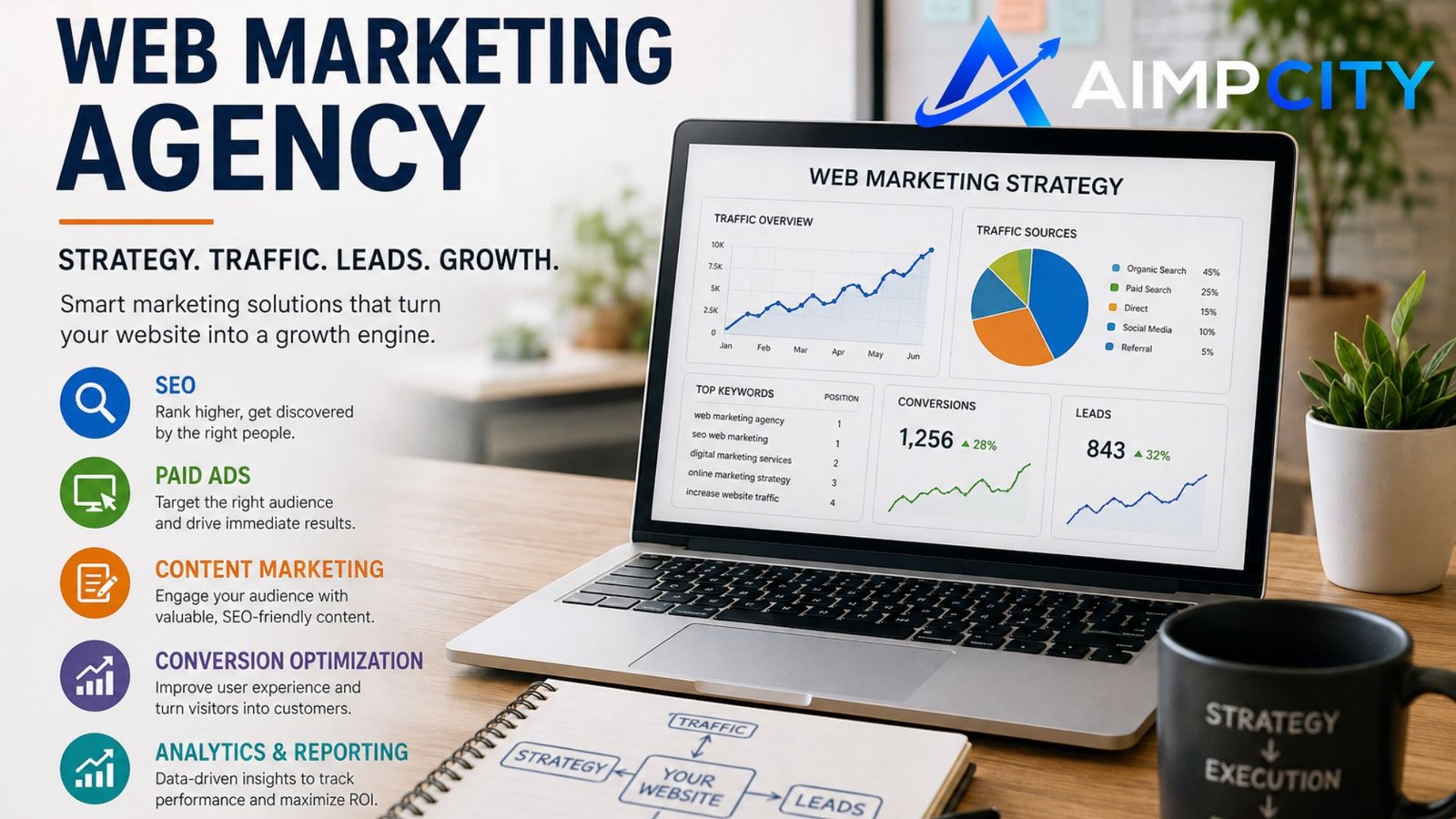
Running a business online can become frustrating when the website looks professional, social accounts are active, and money is being spent on marketing but enquiries or sales still arrive unpredictably. The problem is often not a lack of marketing activity. It is that SEO, advertising, content, website design, analytics, and conversion efforts are working separately instead of supporting one clear business goal.
A capable web marketing agency helps connect those pieces. Rather than simply increasing website visitors, it studies how potential customers discover your business, what they search for, what makes them trust you, and what prevents them from taking action.
That distinction matters. Ten thousand visitors who never enquire may be less valuable than 1,000 visitors who closely match your ideal customer.
This guide explains what web marketing actually involves, how SEO web marketing fits into the bigger picture, what a good agency should do, and how to judge whether your marketing is producing real business growth rather than impressive-looking reports.
What Is a Web Marketing Agency?
A web marketing agency helps businesses attract, engage, and convert customers through internet-based channels.
Depending on the business, its work may include:
- Search engine optimization
- Website strategy
- Content marketing
- Paid search advertising
- Social media marketing
- Email marketing
- Conversion rate optimization
- Analytics and tracking
- Landing page development
- Local search optimization
The important part is not how many services the agency offers. It is how well those services work together.
For example, ranking a service page higher on Google sounds successful. But if visitors reach the page and cannot quickly understand the offer, SEO alone will not produce much revenue.
Good web marketing connects visibility, intent, trust, and conversion.
Web Marketing vs. Traditional Marketing
Traditional marketing usually broadcasts a message to a large audience through channels such as print, radio, television, billboards, or direct mail.
Web marketing works differently because customer behavior can be measured more precisely.
A business can often determine:
- Which search brought someone to the website
- Which page they visited first
- Which advertisement attracted them
- Whether they completed a form
- Which pages influenced a purchase
- Where visitors abandoned the journey
This creates a major advantage: marketing decisions can be based on behavior rather than assumptions.
Traditional advertising may tell you that thousands of people potentially saw a message. Digital marketing can go further and show whether those people clicked, explored, requested information, booked, or purchased.
That feedback loop allows campaigns to improve continuously.
What Does a Web Marketing Agency Actually Do?
A strong agency does more than publish content or launch advertising campaigns. It creates a system for turning online attention into measurable business outcomes.
1. Understands the Customer Before Choosing Channels
One of the most common mistakes in web marketing is selecting tactics before understanding the customer.
A business might immediately decide:
“We need Instagram.”
“We need SEO.”
“We should run Google Ads.”
But the better question is:
Where does our customer go when they actually need our service?
Someone urgently searching for an emergency plumber behaves differently from someone considering a luxury home renovation.
The plumber may benefit heavily from local SEO and paid search because demand already exists.
A renovation company may require educational content, project examples, remarketing, email nurturing, and a longer trust-building process.
Channel selection should follow customer behavior, not marketing trends.
2. Builds a Search Strategy
SEO web marketing focuses on attracting people through search engines when they are researching a problem, comparing solutions, or preparing to buy.
A complete SEO strategy can involve:
- Search intent research
- Keyword mapping
- Technical SEO
- On-page optimization
- Content development
- Local SEO
- Website architecture
- Internal navigation
- Authority building
- Performance monitoring
Good SEO is not simply placing keywords inside articles.
The goal is to create the most useful destination for a particular search intent.
If someone searches “best accounting software for contractors,” they probably want comparisons and decision support.
If they search “accounting software demo,” their intent is much closer to purchasing.
Those searches should normally lead to different pages.
Why SEO Web Marketing Matters
SEO can become one of the most valuable parts of a web marketing strategy because it captures existing demand.
A person searching for a service is actively expressing interest.
That creates a different marketing situation from interrupting someone with an advertisement while they are browsing entertainment content.
However, businesses often misunderstand SEO success.
Higher rankings are useful, but rankings alone should not be the final objective.
A better sequence is:
Relevant rankings → qualified traffic → engagement → enquiries → customers → revenue
If an agency reports dramatic traffic growth without connecting it to business outcomes, the picture is incomplete.
SEO and Paid Advertising Should Not Be Enemies
Businesses sometimes treat SEO and paid search as competing strategies.
In reality, they solve different problems.
SEO usually requires more time but can create sustained organic visibility.
Paid advertising can create immediate exposure but normally stops generating traffic when spending stops.
A practical approach often combines both.
For example, a newly launched service business might use paid search to capture immediate demand while gradually building SEO visibility.
Advertising data can also reveal:
- Which search terms convert
- Which offers attract attention
- Which landing pages perform well
- Which customer problems appear most frequently
Those insights can then strengthen SEO content.
Likewise, organic search data can reveal topics worth testing through paid campaigns.
The strongest marketing systems allow channels to learn from each other.
The Hidden Difference Between Traffic and Useful Traffic
Many marketing reports celebrate increasing traffic.
That can be misleading.
Imagine two companies.
Company A
Receives 20,000 monthly visitors but generates 80 enquiries.
Company B
Receives 5,000 monthly visitors and generates 250 enquiries.
Which website is performing better?
Company B probably has a much healthier marketing system.
Traffic should therefore be evaluated alongside:
- Search intent
- Lead quality
- Conversion rate
- Customer acquisition cost
- Sales qualification rate
- Revenue generated
A smaller audience with stronger commercial intent can be far more valuable.
An Often-Ignored Metric: Traffic-to-Offer Alignment
Here is one issue that many standard marketing guides overlook.
A website can attract exactly the right audience and still fail because its offer does not match what visitors expected.
Suppose someone searches:
“affordable website redesign for small businesses.”
They arrive on a page promoting enterprise digital transformation consulting.
Technically, the visitor may be relevant to web design.
Commercially, however, the offer is mismatched.
I call this traffic-to-offer alignment.
Before trying to double traffic, businesses should ask:
- What did this visitor expect to find?
- Does the landing page immediately match that expectation?
- Is the next action appropriate for their buying stage?
Improving these three points can sometimes outperform months of additional traffic acquisition.
How Conversion Optimization Fits Into Web Marketing
Getting someone to your website is only half the job.
The website must help that person confidently take the next step.
Conversion rate optimization focuses on reducing unnecessary friction.
That may involve improving:
- Headlines
- Calls to action
- Contact forms
- Service descriptions
- Navigation
- Pricing clarity
- Trust signals
- Page speed
- Mobile usability
Consider a professional service company receiving 3,000 targeted visitors per month.
If 1% enquire, it generates 30 leads.
If improvements raise the conversion rate to 2%, the same traffic produces 60 leads.
No additional visitors were required.
This is why traffic acquisition and website conversion should rarely be managed in isolation.
The Marketing Funnel Is Usually Messier Than Reports Suggest
Marketing diagrams often show a clean journey:
Awareness → Consideration → Conversion.
Real customers rarely behave that neatly.
Someone may:
- Discover a business through Google
- Leave the website
- See the brand again through social media
- Search the company name later
- Read reviews
- Return through a direct visit
- Finally submit an enquiry
The final click does not necessarily deserve all the credit.
A good web marketing agency therefore looks beyond simplistic “last-click” thinking and studies the wider customer journey.
This matters especially for high-value services, B2B companies, property businesses, education providers, and products requiring significant consideration.
A Unique Problem: Marketing Handoff Friction
Another overlooked issue occurs after a marketing lead is generated.
Imagine the agency delivers 100 qualified enquiries.
The sales team responds two days later.
Half of those prospects have already contacted competitors.
Marketing may appear unsuccessful even though the actual failure happened after the conversion.
This is marketing handoff friction.
Businesses should examine the period between:
Lead generated → Lead contacted → Lead qualified → Sale completed
Questions worth tracking include:
- How quickly are enquiries answered?
- Are sales staff following a consistent process?
- How many leads are genuinely qualified?
- Why do prospects reject the offer?
- Which marketing sources create actual customers?
Strong agencies increasingly need feedback from the sales process because advertising dashboards alone cannot reveal the complete story.
What Good Web Marketing Reporting Should Include
A useful marketing report should help you make decisions.
It should not bury you under graphs.
Depending on the campaign, useful metrics may include:
- Organic conversions
- Qualified leads
- Conversion rate
- Cost per lead
- Customer acquisition cost
- Revenue influenced by marketing
- Search visibility
- Landing page performance
- Lead quality
- Returning visitor behavior
Metrics such as impressions, clicks, rankings, and traffic are still helpful.
But they should connect to the commercial objective whenever possible.
If your goal is appointments, the most important question is not simply, “Did traffic increase?”
It is:
Did the marketing generate more valuable appointments at a sustainable cost?
How to Choose the Right Web Marketing Agency
Do not choose an agency simply because its website looks impressive.
Ask questions that reveal how it thinks.
Ask How They Measure Success
A credible agency should connect its work to your objectives.
If your priority is lead generation, reporting should eventually connect marketing activity with leads and lead quality.
Ask About Strategy Before Deliverables
Be cautious when an agency immediately recommends:
“Eight blogs per month.”
“Twenty backlinks.”
“Daily social posts.”
Those are activities, not strategies.
The agency should first understand your customers, competitors, positioning, sales process, website performance, and growth goals.
Look for Clear Explanations
Marketing contains plenty of technical language.
A skilled agency should still be able to explain its strategy simply.
If every conversation requires confusing jargon, communication may become difficult later.
Confirm Who Owns the Data
Businesses should retain access to important marketing assets such as analytics accounts, advertising accounts, tracking systems, website platforms, and customer data.
This becomes extremely important if the agency relationship ends.
Data ownership is rarely discussed early enough.
Common Web Marketing Mistakes
Several mistakes repeatedly weaken otherwise good campaigns.
Chasing Every Marketing Channel
More channels do not automatically mean more growth.
It is usually better to perform well on two or three channels where customers are active than maintain weak campaigns across eight platforms.
Publishing Content Without Search Intent
A blog post can be beautifully written and still receive little qualified traffic if nobody is searching for the topic or if the content fails to match their intent.
Sending All Traffic to the Homepage
Advertising campaigns often perform better when visitors reach a page specifically built around their problem or offer.
Optimizing for Vanity Metrics
Followers, impressions, traffic, and rankings can look impressive while revenue remains unchanged.
Ignoring Existing Website Conversion Problems
Paying for more visitors rarely fixes confusing messaging, slow pages, weak offers, or complicated forms.
A Practical Web Marketing Scenario
Consider a local business offering premium home renovation services.
Its marketing challenge is inconsistent enquiries.
A sensible strategy might begin with:
- Researching high-intent local searches.
- Improving service and location pages for SEO.
- Creating dedicated landing pages for paid search.
- Tracking calls and enquiries correctly.
- Publishing content that answers major homeowner concerns.
- Retargeting visitors who explored services but did not enquire.
- Improving forms and calls to action.
- Reviewing which enquiries became profitable projects.
Notice that the strategy does not depend on one channel.
SEO creates long-term visibility.
Paid search captures immediate demand.
Content builds trust.
Retargeting keeps the business familiar.
Conversion optimization improves results from existing visitors.
Analytics reveals where future budget should go.
That is what integrated web marketing looks like.
When Should You Hire a Web Marketing Agency?
Hiring an agency can make sense when your business:
- Needs specialized marketing skills
- Has inconsistent online lead generation
- Wants to scale campaigns
- Lacks internal SEO expertise
- Cannot accurately track performance
- Has traffic but weak conversions
- Needs several marketing channels coordinated
However, outsourcing marketing does not mean completely handing over responsibility.
The best agency relationships involve collaboration.
Your company understands the customers, products, operations, and sales conversations.
The agency brings research, execution, marketing expertise, testing, and outside perspective.
Combining both usually produces better decisions.
Conclusion
A web marketing agency should do much more than bring people to your website.
Effective web marketing connects customer intent, SEO, advertising, content, website experience, analytics, and conversion strategy into one measurable system.
The strongest results often come from fixing overlooked gaps: attracting the right visitors, matching those visitors with the right offer, removing conversion friction, and ensuring leads are handled properly after they arrive.
Before increasing your marketing budget, examine the entire customer journey. More traffic is useful only when the system behind that traffic can turn attention into trust, enquiries, customers, and sustainable growth.
Frequently Asked Questions
What does a web marketing agency do?
A web marketing agency helps businesses attract and convert customers through online channels such as SEO, paid advertising, content, email, and website optimization. A good agency also measures how these activities influence leads or sales. Its real role is not simply increasing online activity but improving the complete path from discovery to conversion.
What is SEO web marketing?
SEO web marketing is the process of using search engine optimization as part of a wider online marketing strategy. It includes improving website structure, content, relevance, technical performance, and search visibility. The objective is to attract people who are actively searching for information, products, or services related to the business.
Is web marketing the same as digital marketing?
The terms are often used interchangeably because both involve promoting businesses through digital channels. Web marketing generally focuses more specifically on internet-based activities such as websites, search engines, online advertising, content, and email. Digital marketing can also include broader digital channels beyond the web.
How long does web marketing take to produce results?
The timeline depends heavily on the channel. Paid advertising can begin generating visits and enquiries relatively quickly, while SEO usually requires sustained work before strong organic visibility develops. Conversion improvements may produce faster gains when a website already receives significant traffic.
How can I tell if a web marketing agency is performing well?
Start with business outcomes instead of activity reports. Look at qualified leads, conversions, acquisition costs, revenue contribution, organic visibility, and landing-page performance. Good agencies should also explain what changed, why it changed, and what they plan to test next.
Should a small business hire a web marketing agency?
It can be worthwhile when the business lacks the time or expertise to manage SEO, advertising, analytics, and conversion optimization internally. However, a small business does not necessarily need every available marketing service. The best approach is usually to identify the few channels most closely connected to customer demand and build from there.
