

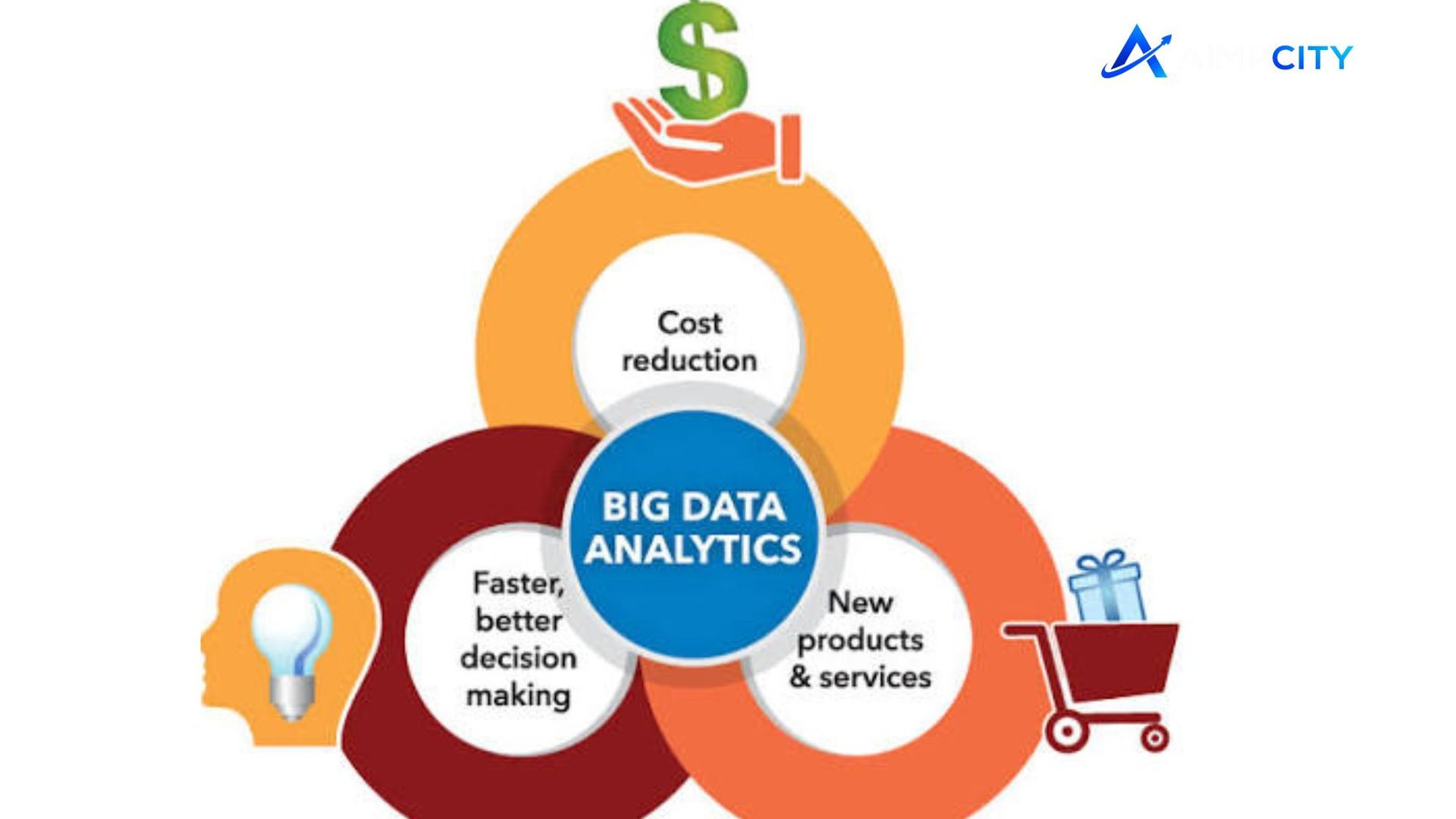
Big data analytics is the process of examining large, complex datasets to uncover patterns, trends, relationships, and actionable insights. It brings together data from sources such as transactions, websites, mobile devices, social media, sensors, applications, and connected machines. The goal is not simply to collect more information, but to use it to make better decisions.
For businesses, this can mean identifying changing customer preferences, improving operations, detecting unusual activity, forecasting demand, or finding opportunities that conventional reporting might miss. Modern analytics can work with structured, semi-structured, and unstructured data, making it useful across many industries.
What Is Big Data Analytics?
At its core, big data analytics combines data management, statistical analysis, data mining, machine learning, and visualization to extract useful information from datasets that can be too large or complex for traditional approaches.
The scale is only part of the challenge. Big data is commonly described through characteristics such as volume, velocity, variety, veracity, and value. Data may arrive rapidly, appear in different formats, vary in quality, and come from numerous systems. NIST also emphasizes scalable architectures for handling the volume, velocity, and variety associated with big data.
For example, an online retailer could combine purchase histories, website activity, product reviews, inventory records, and customer-service interactions. An analytical system can then identify purchasing patterns and help the retailer make more informed decisions.
How Big Data Analytics Works
A successful analytics environment usually involves several connected stages:
- Data collection: Information is gathered from databases, applications, devices, websites, transactions, sensors, and other sources.
- Data storage: Large datasets are stored using technologies suited to their scale and structure, such as data lakes, warehouses, or lakehouse architectures.
- Data preparation: Duplicate, incomplete, inconsistent, or irrelevant records are identified and addressed.
- Data processing: Systems transform and organize information so analytical workloads can operate efficiently.
- Analysis: Statistical techniques, data mining, machine learning, or other methods are applied to identify meaningful patterns.
- Visualization and action: Findings are presented through reports, dashboards, alerts, or predictive models so decision-makers can act on them.
This workflow matters because sophisticated algorithms cannot compensate for unreliable source data. Data quality, integration, privacy, and security remain central concerns throughout the process.
Four Main Types of Analytics
Different analytical approaches answer different business questions:
| Analytics type | Main question | Typical use |
|---|---|---|
| Descriptive | What happened? | Sales and performance reporting |
| Diagnostic | Why did it happen? | Identifying causes of a decline |
| Predictive | What may happen next? | Demand or risk forecasting |
| Prescriptive | What should we do? | Recommending an action or strategy |
These approaches can work together. An organization might first identify a decline in sales, investigate its causes, predict future demand, and then use those findings to determine an appropriate response.
Benefits of Big Data Analytics
The strongest business case for big data analytics is its ability to turn scattered information into evidence that supports decisions.
Better decision-making: Organizations can identify relationships and trends that are difficult to see when information is examined in isolation.
Operational efficiency: Analysis can reveal bottlenecks, unnecessary costs, resource constraints, and opportunities for process improvement.
Customer understanding: Combining behavioral, transactional, and feedback data can provide a clearer picture of customer needs and preferences.
Risk management: Analytical models can help identify unusual patterns and potential risks earlier, allowing organizations to investigate them before they become larger problems.
Forecasting: Historical information combined with statistical or machine-learning methods can support predictions about demand, customer behavior, maintenance needs, and other outcomes.
IBM identifies faster decision-making, cost reduction, improved customer engagement, and stronger risk management among the potential benefits of these analytical capabilities.
💡 Pro Tip: Start with one measurable business question instead of trying to analyze every available dataset. Define the decision you want to improve, identify the minimum relevant data, and establish a success metric before selecting analytical tools.
Common Applications
Big data analytics is used across industries because large-scale information exists in almost every modern operation.
Retail: Companies can analyze purchasing behavior, inventory movement, pricing information, and customer interactions to improve merchandising and demand planning.
Finance: Financial organizations can examine transaction patterns and other signals to support fraud detection, risk analysis, and customer insights.
Healthcare: Organizations can analyze clinical, operational, and other authorized datasets to support research, planning, and more informed decisions.
Manufacturing: Sensor and equipment data can be examined to identify abnormal conditions and support predictive maintenance.
Transportation: Fleet, route, traffic, and operational information can help organizations understand performance and improve planning.
Marketing: Customer interactions across digital channels can reveal audience behavior and help evaluate campaign performance.
These applications illustrate why analytics is broader than traditional business reporting. It can combine different forms of information and use advanced techniques to discover patterns that would otherwise remain hidden.
Technologies Behind Big Data Analytics
A modern analytics environment may combine several technologies rather than relying on one platform. Distributed processing frameworks such as Apache Hadoop and Apache Spark are associated with large-scale data processing, while NoSQL databases can support data that does not fit neatly into conventional relational structures.
Cloud platforms can also provide scalable storage and computing resources. Data lakes and lakehouses are commonly considered when organizations need flexibility for diverse datasets alongside analytical workloads.
Artificial intelligence and machine learning add another layer. Machine-learning models can identify patterns, classify information, generate forecasts, and support automated or semi-automated decisions. The usefulness of these models still depends heavily on appropriate data, sound methodology, and ongoing evaluation.
Challenges to Consider
More data does not automatically produce better results. Organizations can face several practical obstacles.
Poor data quality: Missing, duplicated, outdated, or inconsistent information can undermine analytical results.
Integration: Combining information from incompatible systems may require substantial engineering and governance work.
Privacy and security: Sensitive information must be protected with appropriate access controls, security practices, and regulatory compliance.
Scalability: Storage and computing requirements can increase as datasets become larger and analytical workloads become more demanding.
Skills: Effective programs often require expertise across data engineering, analytics, statistics, machine learning, governance, and business operations.
These challenges make governance particularly important. Organizations need clear ownership, quality standards, access policies, and processes for maintaining trustworthy information.
📌 Key Takeaway: Big data analytics creates value when large and diverse datasets are connected to a clear business or operational objective. The technology matters, but reliable data, appropriate analytical methods, strong governance, and actionable outcomes matter just as much.
Frequently Asked Questions
What is the main purpose of big data analytics?
Its main purpose is to extract useful insights from large and complex datasets. Organizations use those insights to understand what happened, investigate why it happened, forecast possible outcomes, and support better decisions.
What is the difference between big data and traditional data analytics?
Traditional analytics often focuses on structured information in relational databases. Big data analytics must frequently handle much larger datasets as well as structured, semi-structured, and unstructured information, requiring scalable storage and processing technologies.
Is big data analytics only useful for large companies?
No. The appropriate scale depends on the organization’s data and objectives. Smaller organizations can apply the same principles to customer, operational, financial, or website data without building an extremely complex infrastructure.
How does machine learning relate to big data?
Machine learning is one analytical technique that can be applied to large datasets. It can identify patterns and generate predictions, but useful results depend on relevant, sufficiently reliable data and appropriate model development and evaluation.
What is the biggest challenge in using large datasets?
There is no single universal challenge. Data quality, integration, privacy, security, scalability, and skills can all become significant obstacles. In practice, a strong data-management foundation is essential before advanced analytics can deliver dependable results.
Conclusion
Big data analytics turns high-volume, diverse information into insights that can guide business and operational decisions. Its value comes from connecting the right data with a meaningful question, reliable processes, suitable analytical methods, and clear action.
Organizations do not need to analyze everything they collect. A focused strategy built around trustworthy data and measurable objectives is usually a stronger starting point than simply accumulating more information.
