

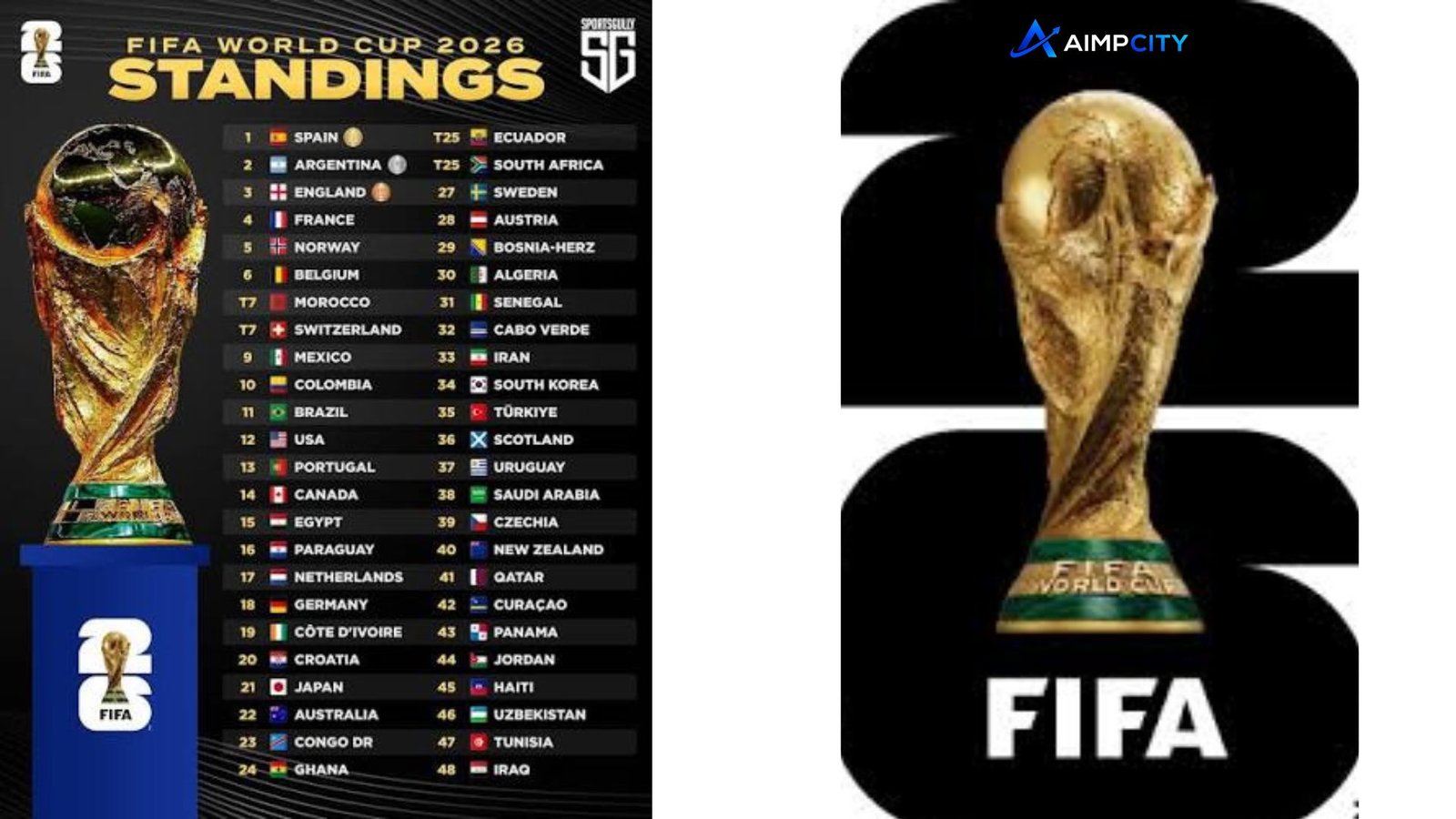
The FIFA World Cup 2026 standings are now final after 48 teams competed across 12 groups in the expanded tournament hosted by the United States, Canada and Mexico. Spain eventually lifted the trophy after beating Argentina 1-0 after extra time in the final, but the group stage produced plenty of decisive moments long before the knockout rounds began.
For fans checking the FIFA World Cup 2026 standings, the key numbers are matches played, wins, draws, losses, goals scored, goal difference and points. The tournament used a new 48-team format, with the top two teams from each group plus the eight best third-place teams advancing to the Round of 32.
FIFA World Cup 2026 standings: Final group tables
The final tables below show how every group finished after all three group-stage matches.
| Group | 1st | 2nd | 3rd | 4th |
|---|---|---|---|---|
| A | Mexico — 9 pts | South Africa — 4 | South Korea — 3 | Czechia — 1 |
| B | Switzerland — 7 | Canada — 4 | Bosnia & Herzegovina — 4 | Qatar — 1 |
| C | Brazil — 7 | Morocco — 7 | Scotland — 3 | Haiti — 0 |
| D | United States — 6 | Australia — 4 | Paraguay — 4 | Türkiye — 3 |
| E | Germany — 6 | Côte d’Ivoire — 6 | Ecuador — 4 | Curaçao — 1 |
| F | Netherlands — 7 | Japan — 5 | Sweden — 4 | Tunisia — 0 |
| G | Belgium — 5 | Egypt — 5 | Iran — 3 | New Zealand — 1 |
| H | Spain — 7 | Cape Verde — 3 | Uruguay — 2 | Saudi Arabia — 2 |
| I | France — 9 | Norway — 6 | Senegal — 3 | Iraq — 0 |
| J | Argentina — 9 | Austria — 4 | Algeria — 4 | Jordan — 0 |
| K | Colombia — 7 | Portugal — 5 | DR Congo — 4 | Uzbekistan — 0 |
| L | England — 7 | Croatia — 6 | Ghana — 4 | Panama — 0 |
The final group tables show several close races. Brazil and Morocco both finished on seven points in Group C, while Belgium and Egypt were level on five points in Group G. Australia and Paraguay also ended Group D with four points apiece. The final rankings reflected the applicable tiebreaking criteria.
How the 2026 World Cup standings worked
The expanded competition featured 12 groups of four teams. Each nation played three group matches, with three points awarded for a win and one for a draw.
The most important change was what happened after the group stage. Rather than sending only two teams from each group directly into a traditional Round of 16, the 2026 tournament introduced a Round of 32. The top two teams from all 12 groups qualified, joined by the eight best third-place teams.
This made third place significantly more valuable. A team could lose one match, collect enough points and still have a realistic route into the knockout phase depending on results elsewhere.
What the columns mean
When reading FIFA World Cup 2026 standings, these abbreviations are useful:
- MP: Matches played
- W: Wins
- D: Draws
- L: Losses
- GF: Goals scored
- GA: Goals conceded
- GD: Goal difference
- PTS: Points
Goal difference is calculated by subtracting goals conceded from goals scored. It can become crucial when teams finish level on points.
💡 Pro Tip: When two teams have the same number of points, do not assume overall goal difference is always the first deciding factor. World Cup ranking rules can use head-to-head criteria before overall statistics, so check the official tournament rules when a close group needs clarification.
Which teams topped their groups?
Several major football nations finished first, including Spain, France, Argentina, England, Germany and the United States.
Mexico produced a perfect nine-point record in Group A, while France and Argentina also won all three group matches. The Netherlands, Brazil, Colombia and England were among the other group winners who finished strongly.
Spain’s seven points in Group H came without conceding a goal. France also recorded nine points in Group I, while Argentina finished Group J with nine points and an impressive +7 goal difference.
The United States finished first in Group D with six points. The USMNT secured qualification despite losing its final group match to Türkiye, with Australia taking second place and Paraguay finishing third.
What happened to the third-place teams?
The third-place positions were especially significant in the expanded tournament. Eight of the 12 third-place teams advanced to the knockout stage.
The final third-place positions included South Korea, Scotland, Paraguay, Ecuador, Sweden, Iran, Uruguay, Senegal, Algeria, DR Congo and Ghana, alongside the remaining group finishers. Their prospects depended not simply on finishing third but on how their points and other ranking criteria compared with third-place teams elsewhere.
This format added another layer to the FIFA World Cup 2026 standings because a third-place finish was no longer automatically the end of a team’s tournament.
How the standings shaped the knockout stage
Group position mattered beyond qualification. Finishing first or second influenced the Round of 32 pathway and the potential route through the bracket. That meant teams had an incentive to chase victories even after qualification was secured.
The tournament ultimately featured 104 matches, making it the largest World Cup edition by number of participating teams and games. Spain completed the competition as champions, defeating Argentina 1-0 after extra time in New York New Jersey on July 19, 2026.
Spain’s title was its second men’s World Cup championship, following the country’s 2010 triumph. The final also completed a tournament that FIFA described as the first 48-team World Cup.
📌 Key Takeaway: The final FIFA World Cup 2026 standings show how closely contested several groups were, particularly where teams finished level on points. Because the 2026 format included eight best third-place qualifiers, points, goal difference and tiebreakers mattered across the entire group-stage table.
Frequently Asked Questions
How many teams qualified for the 2026 World Cup knockout stage?
Thirty-two teams advanced from the group stage. The 12 group winners, 12 runners-up and eight best third-place teams moved into the newly introduced Round of 32. This was one of the major structural changes created by expanding the World Cup from 32 to 48 teams.
Who won the 2026 FIFA World Cup?
Spain won the 2026 FIFA World Cup. La Roja defeated Argentina 1-0 after extra time in the final at New York New Jersey Stadium, with Ferran Torres scoring the decisive goal in the 106th minute. It was Spain’s second men’s World Cup title.
Did the United States qualify from its group?
Yes. The United States finished first in Group D with six points from three matches. Australia finished second on four points, while Paraguay also collected four points but ended third. The United States therefore advanced to the knockout stage as group winners.
Why were some teams tied on points ranked differently?
The tournament used tiebreaking criteria to separate teams with equal points. These included head-to-head points, head-to-head goal difference, head-to-head goals, overall goal difference, overall goals scored, conduct score and FIFA ranking, in the applicable order.
Where can fans check official World Cup standings?
FIFA’s official World Cup coverage is the best source for tournament information, while established sports outlets also provide live and final tables. For historical or official tournament records, FIFA’s competition pages should be treated as the primary reference.
Conclusion
The final FIFA World Cup 2026 standings reflect a tournament that changed the traditional group-stage equation. With 48 teams, 12 groups and eight third-place qualifiers, teams had more routes into the knockout rounds but also more reasons to protect points and improve goal difference.
Spain ultimately finished the tournament on top of the world, but the group tables tell the story of how every team reached — or missed — the knockout stage. For future reference, checking points alongside goal difference and the official tiebreaking rules gives the clearest picture of how the competition was decided.
