

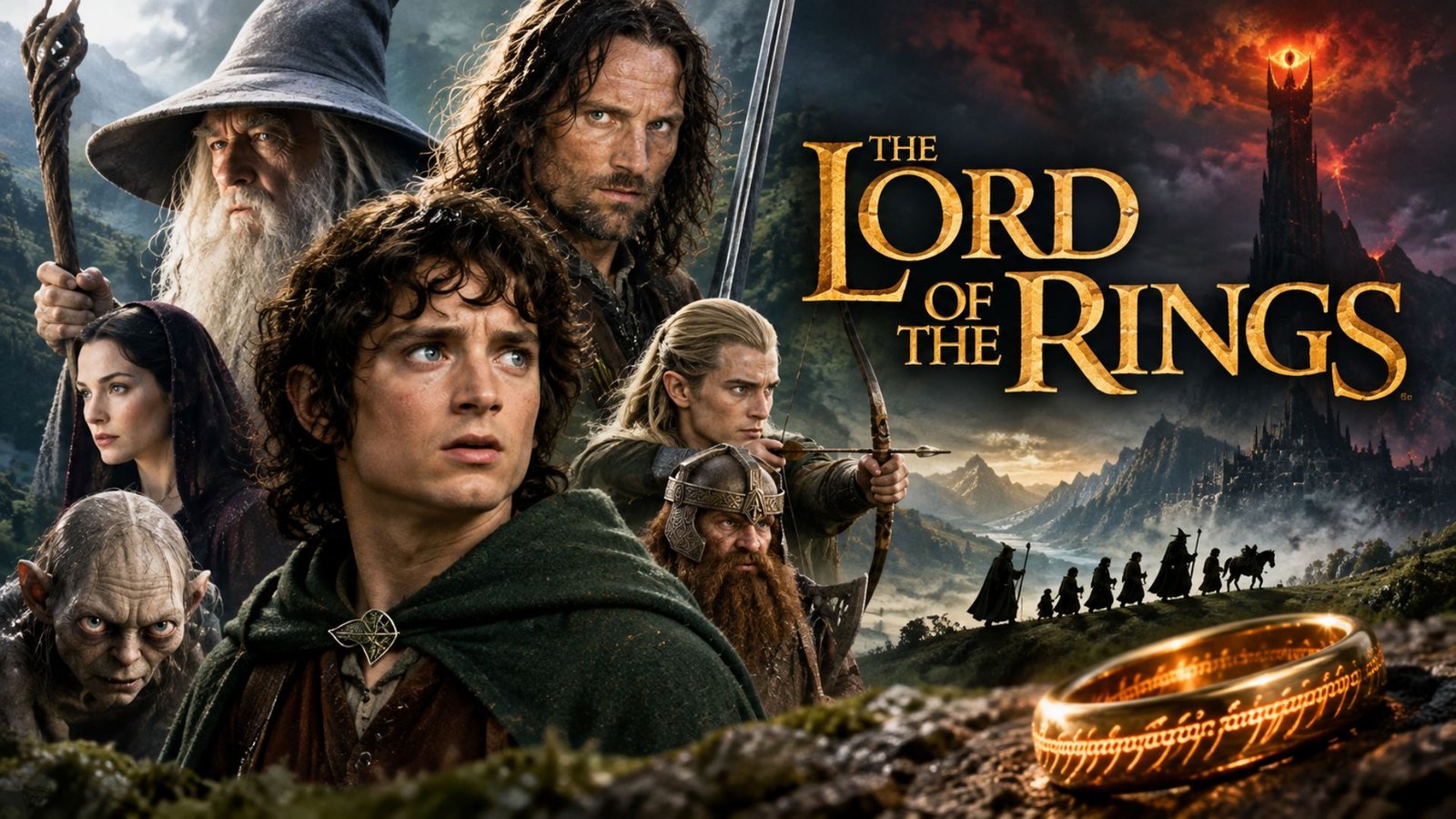
The Lord of the Rings is one of the defining works of modern fantasy, but its appeal goes beyond elves, wizards, battles, and mythical kingdoms. J.R.R. Tolkien built Middle-earth around questions of friendship, temptation, courage, power, loss, and the cost of choosing what is right when the easier path is often destructive. For readers discovering the story for the first time, the biggest question is usually where to begin and how the books connect to Peter Jackson’s famous film trilogy.
The original story is a novel in three volumes, while the films adapt that material into three major motion pictures. Knowing the difference helps make sense of the reading order, the characters, and the many places and histories that surround the central quest.
What Is The Lord of the Rings About?
At its center, The Lord of the Rings follows Frodo Baggins, a Hobbit from the Shire, after he inherits the One Ring. The Ring is not an ordinary treasure: it is the instrument through which the Dark Lord Sauron can regain power. Gandalf discovers the danger, and Frodo eventually leaves the Shire with a small group of companions.
The quest becomes a journey to destroy the Ring in the fires of Mount Doom, the place where it was made. That task draws the characters far beyond the familiar landscapes of the Shire and into conflicts involving Gondor, Rohan, Mordor, Isengard, and many other parts of Middle-earth.
The Books and the Film Trilogy
The novel was published in three volumes: The Fellowship of the Ring, The Two Towers, and The Return of the King. They form one continuous narrative rather than three unrelated stories.
Peter Jackson’s film adaptation follows the same broad structure. The three films were released between 2001 and 2003, bringing Tolkien’s world to a global movie audience. Warner Bros. records list the three films as The Fellowship of the Ring, The Two Towers, and The Return of the King.
| Part | Main focus | What readers or viewers encounter |
|---|---|---|
| The Fellowship of the Ring | The Ring leaves the Shire | Frodo’s journey begins and the Fellowship is formed |
| The Two Towers | The quest divides | Rohan, Isengard, Sam and Frodo, and the growing war |
| The Return of the King | The final struggle | Gondor, the battle for Middle-earth, and the Ring’s fate |
The books contain more background, history, songs, languages, and character development than a film adaptation can present. The movies necessarily condense some material and rearrange certain events for cinematic pacing.
Who Are the Main Characters?
The strength of The Lord of the Rings comes partly from its ensemble of characters. Frodo carries the central burden, but the story is never presented as a one-person victory.
Samwise Gamgee becomes Frodo’s most steadfast companion. His role gives the journey an emotional center because his loyalty continues even when hope is nearly exhausted. Aragorn begins as a mysterious ranger and gradually reveals his connection to the kingship of Gondor. Gandalf serves as a guide, but his role changes significantly as the danger grows.
READ ALSO :Brittany Mahomes: Essential Facts About Her Life & Career
Why Middle-earth Feels So Detailed
Tolkien did not treat Middle-earth as a simple backdrop. Its peoples, languages, legends, family histories, landscapes, and ancient conflicts give the main story a sense of depth.
The Shire represents a comparatively peaceful way of life, while Mordor embodies the destructive power of Sauron. Between them are places with their own histories and political pressures. Rohan and Gondor, for example, are not merely locations for battles; they have distinct cultures, rulers, traditions, and relationships.
💡 Pro Tip
If you are reading the books for the first time, resist the urge to memorize every place-name and family line immediately. Follow the characters and the main journey first. The deeper history becomes much easier to appreciate once the central story is familiar.
The Lord of the Rings on Screen
Jackson’s trilogy became a major cinematic interpretation of Tolkien’s work. The films were directed by Peter Jackson, with screenplays credited to Jackson, Fran Walsh, and Philippa Boyens for the trilogy’s major adaptations. The Academy’s records document nominations for all three films, while The Return of the King won all 11 of its nominations at the 76th Academy Awards.
The movies are notable for their large-scale production work, costumes, sets, visual effects, and Howard Shore’s musical score. Yet their appeal is not simply technical spectacle. The relationships between Frodo and Sam, Aragorn and his companions, and the wider Fellowship give the battles personal stakes.
For newcomers, watching the trilogy in release order is straightforward: The Fellowship of the Ring, The Two Towers, then The Return of the King. Readers can use the same order for the novels.
What Makes the Story Still Relevant?
The Lord of the Rings continues to attract new audiences because its central conflicts are easy to understand even within an elaborate fantasy setting. Power can corrupt. Fear can shape decisions. Friendship can sustain people through impossible circumstances. Ordinary individuals can become important without possessing extraordinary abilities.
For readers who enjoy world-building, the books offer languages, mythology, poetry, geography, and history. For movie fans, the trilogy provides a more immediate route into the same fictional world.
📌 Key Takeaway
The Lord of the Rings works best when viewed as both a fantasy adventure and a story about responsibility. Start with The Fellowship of the Ring, follow the three-part narrative in order, and explore Middle-earth’s deeper history only as your interest grows.
Frequently Asked Questions
Is The Lord of the Rings one book or three?
It is one continuous novel that was published in three volumes: The Fellowship of the Ring, The Two Towers, and The Return of the King. Tolkien conceived the work as a single story, although publishing history led to its familiar three-volume form.
What is the correct order to watch the movies?
Watch The Fellowship of the Ring first, followed by The Two Towers and The Return of the King. This is the release order and also follows the main progression of the story.
Is The Lord of the Rings connected to The Hobbit?
Yes. The Hobbit takes place earlier in Middle-earth’s chronology and introduces Bilbo Baggins, Gollum, and the discovery of the Ring. The Lord of the Rings follows later, with Frodo becoming the Ring-bearer.
Are the books different from the movies?
Yes. The films preserve the central storyline but cannot include every character, song, historical detail, or episode from Tolkien’s books. Some events are condensed, combined, or presented differently for cinematic pacing.
Why is the Ring so dangerous?
The Ring was created by Sauron to increase and concentrate his power. It can influence those who possess it and is extremely difficult to willingly destroy. Its danger is therefore both physical and psychological.
Conclusion
The Lord of the Rings remains a landmark fantasy story because its enormous world never overwhelms its human-scale themes. The journey from the Shire to Mordor is filled with battles and mythology, but the most memorable moments often come from loyalty, sacrifice, temptation, and the choices characters make under pressure. Whether you begin with Tolkien’s books or Jackson’s films, the story offers a rich entry point into Middle-earth and a narrative that rewards deeper exploration.
