

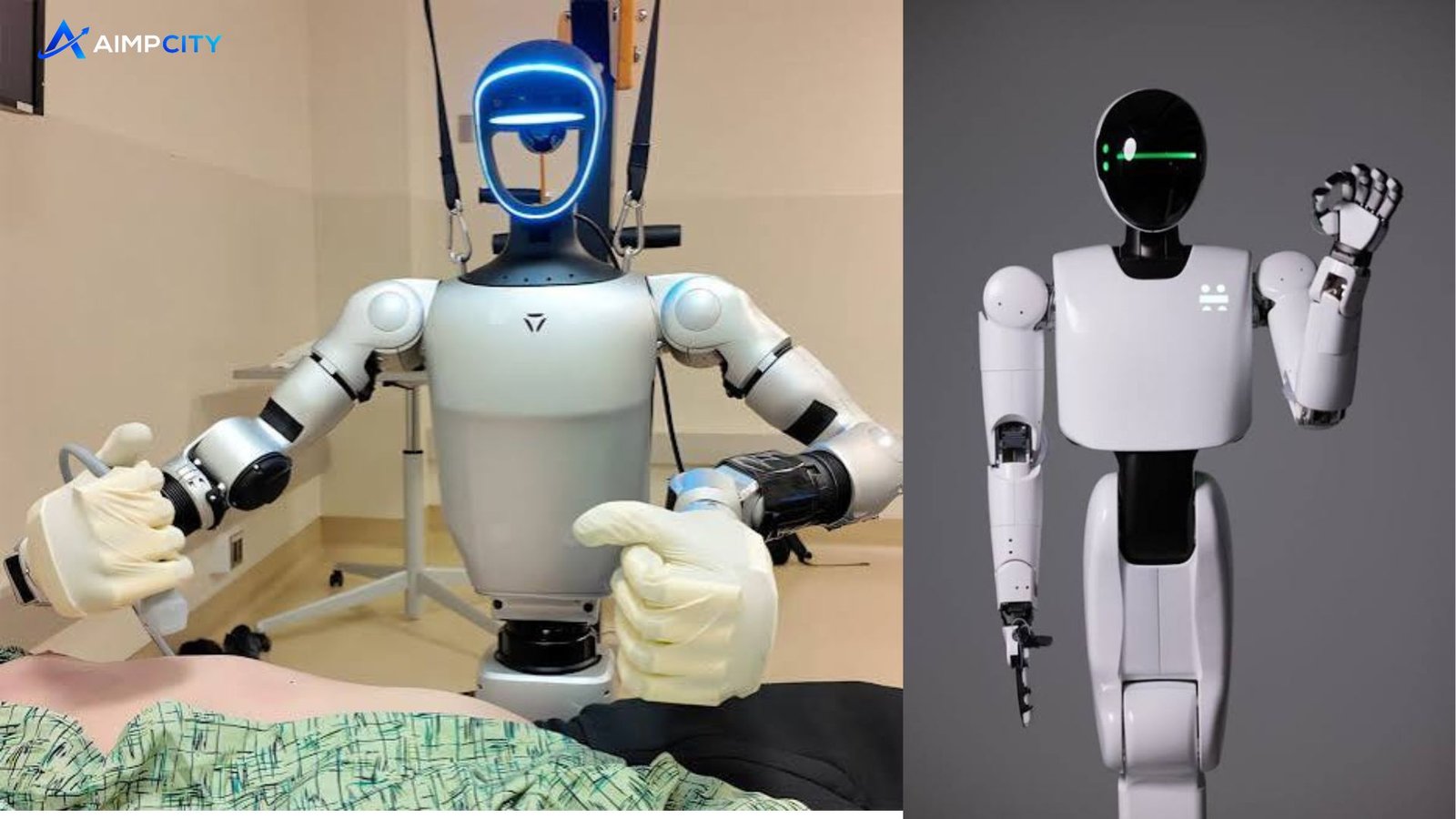
Humanoid robots are moving from impressive demonstrations toward practical work, making humanoid robots news increasingly relevant to manufacturers, investors, technology professionals, and consumers. In 2026, the biggest developments are not simply about robots walking or lifting objects. The real story is the race to combine capable hardware, artificial intelligence, training data, manufacturing scale, safety systems, and commercially useful tasks.
The United States remains a major center of development, with companies such as Figure, Agility Robotics, and Apptronik pushing robots into factories, warehouses, and data-collection environments. At the same time, Chinese companies are advancing rapidly, increasing competitive pressure across the industry.
The latest humanoid robots news from the U.S.
One of the clearest trends is the shift from prototypes to larger fleets. Figure says its BotQ manufacturing facility increased production of its Figure 03 robot from one unit per day to one per hour, while more than 350 third-generation robots had been delivered by April 2026.
Figure has also moved beyond simple demonstrations. Its Figure 03 reached BMW Group’s Spartanburg plant in June, where it was demonstrated handling a more complex logistics workflow. Figure says its earlier Figure 02 deployment contributed to the assembly of 30,000 cars in 2025.
Another significant development is the growing importance of physical AI. Figure’s Helix 02 is designed to coordinate walking, balance, sensing, and manipulation through one neural system. The company has demonstrated autonomous household tasks and cooperation between two humanoid robots.
Agility Robotics is taking a different but equally practical route with Digit. The company is focused heavily on logistics and manufacturing, while continuing to develop safety, charging, recovery, and other capabilities for commercial environments. Toyota Motor Manufacturing Canada has also signed a commercial Robots-as-a-Service agreement following a pilot.
Why AI and training data are becoming the real battleground
The most important shift in humanoid robots news may be happening inside the software rather than the robot’s visible body.
A useful humanoid needs to interpret a changing environment, identify objects, understand instructions, maintain balance, manipulate different materials, and recover when something goes wrong. Pre-programming every possible situation is unrealistic. Developers therefore increasingly rely on vision-language-action systems and large collections of physical-world training data.
Figure’s August 2026 announcement about its Index dataset illustrates this direction. The company says its system had processed millions of uploaded videos and was being developed to expand the amount and diversity of data available for training humanoid systems. It also announced plans for substantial investment in data and computing resources.
Apptronik is pursuing a similar data-driven strategy. Its Robot Park facility in Austin is designed to collect real-world data from Apollo 2 robots, with the company working with Google DeepMind on humanoid intelligence.
This suggests that future competition may depend less on which company builds the most visually impressive robot and more on who can create the strongest combination of hardware, data, AI models, simulation, and real-world deployment.
💡 Pro Tip: When evaluating a humanoid robotics company, look beyond demonstration videos. Check whether its robots are performing repeatable tasks at customer sites, how much human supervision is required, and whether the company is building a scalable manufacturing and software infrastructure.
Which companies are leading the race?
The market is becoming crowded, but the leading projects have noticeably different priorities.
| Company | Robot | Main 2026 focus | Notable development |
|---|---|---|---|
| Figure | Figure 03 | Manufacturing, logistics, home tasks | Production scaling and BMW deployment |
| Agility Robotics | Digit | Warehousing and manufacturing | Commercial deployments and safety improvements |
| Apptronik | Apollo 2 | Industrial work and data collection | Robot Park expansion with AI training |
| Tesla | Optimus | General-purpose automation | Long-term factory and consumer ambitions |
| Chinese robotics firms | Multiple platforms | Industrial, commercial and research uses | Rapid expansion and intense competition |
For readers following humanoid robots news, the key distinction is commercialization. A robot that can complete a controlled demonstration is not automatically ready for thousands of hours in a factory. Reliability, maintenance, safety, battery performance, operating costs, and integration with existing workflows can determine whether a technically impressive machine becomes a viable business.
What is holding humanoid robots back?
Several obstacles remain substantial.
Reliability: Real workplaces are unpredictable. Objects move, floors vary, people interrupt tasks, and machines fail. Robots must handle these situations consistently.
Energy: Walking, lifting, balancing, and manipulating objects require significant power. Battery capacity and charging infrastructure therefore remain important constraints.
Dexterity: Human hands can adapt to thousands of objects and materials. Reproducing that flexibility mechanically and through AI remains difficult.
Safety: Robots operating around people need dependable sensing, motion control, emergency stopping, and operational safeguards. Agility, for example, continues to add safety capabilities as Digit moves toward broader commercial deployment.
Economics: Customers need a clear reason to adopt a humanoid rather than use conventional automation, redesign a process, or employ people. The business case must include purchase or service costs, maintenance, training, downtime, and productivity.
These limitations explain why much of the current humanoid robotics market is focused on structured industrial environments rather than unrestricted household use.
Why the UK and wider market should pay attention
The UK is not absent from this race. Its strength in artificial intelligence, semiconductor design, research, and industrial technology gives it an important role in the broader robotics ecosystem.
Arm CEO Rene Haas recently highlighted expectations for substantial humanoid robotics growth over the next several years while also pointing to chip shortages as a constraint on progress.
For Britain, the opportunity extends beyond building complete humanoid robots. Companies supplying processors, sensors, motors, batteries, control systems, AI software, and industrial infrastructure could all benefit from wider adoption.
Meanwhile, developments in China are increasing the competitive pressure. Recent testing has shown how quickly Chinese robotics teams are improving mobility and real-world capabilities, although major reliability and energy challenges remain.
What should readers expect next?
The next phase is likely to be defined by measurable deployment rather than viral demonstrations.
Expect more pilots in factories and warehouses, larger robot fleets, improved AI models, greater use of real-world training data, and more attention to operating economics. Home robots will continue to attract interest, but domestic environments are substantially harder than controlled industrial spaces.
That makes commercial deployment an important benchmark. If a humanoid can reliably perform a narrow task thousands of times, companies can gradually expand its responsibilities. The path to a general-purpose robot may therefore come through many specialized successes rather than one dramatic breakthrough.
📌 Key Takeaway: The strongest humanoid robots news is no longer simply about robots that look human. The meaningful progress is in robots that can learn, operate safely, work repeatedly in real environments, and generate enough economic value to justify deployment.
Frequently Asked Questions
What are the biggest humanoid robot developments in 2026?
The major developments include greater commercial deployment, faster manufacturing, stronger vision-language-action systems, larger physical training datasets, and partnerships with manufacturers. Figure, Agility Robotics, and Apptronik are among the U.S. companies emphasizing real-world applications rather than laboratory demonstrations alone.
Are humanoid robots being used in real factories?
Yes. Humanoid robots are beginning to appear in industrial and logistics environments. Figure has demonstrated Figure 03 at BMW’s Spartanburg facility, while Agility’s Digit has been developed specifically for logistics and manufacturing applications. Commercial deployments remain relatively early compared with conventional industrial automation.
Will humanoid robots replace human workers?
A complete replacement of human labor is not currently supported by the evidence. Today’s systems are primarily being developed for repetitive, physically demanding, or structured tasks. More realistically, early adoption is likely to change specific jobs and workflows while allowing workers to focus on tasks requiring judgment, communication, supervision, or flexibility.
Why is training data so important for humanoid robots?
Physical environments contain enormous variation. Training data can help AI systems learn how objects behave, how people move, and how actions affect the surrounding environment. Companies are therefore investing heavily in real-world data collection because internet text and images alone cannot fully teach a robot how to physically interact with the world.
When will humanoid robots become common in homes?
There is no reliable date for mass household adoption. Home environments are less predictable than factories and require robots to safely handle countless objects, layouts, people, and unexpected situations. Progress in autonomy is substantial, but affordability, reliability, safety, and useful everyday performance will determine when household humanoids become practical.
The direction of humanoid robots news is becoming clearer: the industry is moving from impressive prototypes toward the harder question of dependable economic value. The companies that succeed will need more than a capable robot. They will need reliable AI, abundant training data, scalable production, safe operation, and customers willing to pay for measurable results.
